Part I. The Domain System
1. Domain, Mission, and Core

A domain establishes the area in which a mission operates. The mission grounds a Core by giving it a shared purpose and a basis for judgment and action.
Example
The Research Infrastructure Core exists in a foundational, broad-based domain called Research Infrastructure. Its mission is to maintain and advance the shared public research record so that knowledge remains identifiable, attributable, discoverable, inspectable, executable where applicable, correctable, and preservable.
2. Public Functions, Actors, and Outcomes

A public function is an ability that must remain available for actors in the system to produce outcomes. Such a function exists outside both projects and institutions. It must remain available even as particular projects and institutions change or end. The function persists as the systems, technologies, and arrangements that enable it evolve or are replaced. Its definition is independent of any single application, implementation, project, or institution.
Every actor in a domain engages with its public functions. Actors exercise those functions or enable them, and one actor may occupy both of those roles.
An outcome is a realized result of an actor's work.
Example
For the Research Infrastructure Core, stewarded public functions include
- distinguishing and consistently referring to a research object across systems and time;
- establishing and verifying its attribution and provenance;
- finding it across repositories and institutions;
- retrieving and inspecting it and its supporting evidence;
- executing its computational components where applicable;
- recording and discovering corrections without erasing prior versions;
- and preserving an authentic, usable record that persists across technical and institutional change.
Researchers, research groups, institutions, communities, and machines exercise these functions to produce findings, corrections, preserved records, and other research outcomes. A research team might discover and combine attributable datasets held by several institutions, inspect their provenance, execute the methods needed to analyze them, and produce a new finding. The new finding is the outcome of that team's work. The shared public research record is a function that enabled the team to find, inspect, attribute, and use the prior work.
Technologists, maintainers, operators, librarians, archivists, standards contributors, and infrastructure organizations enable these functions by creating and sustaining the systems and arrangements that make them available. Their work produces new or improved protocols, standards, services, preservation capacity, interoperability, continuity, and capabilities for research.
3. Infrastructure and Dependencies
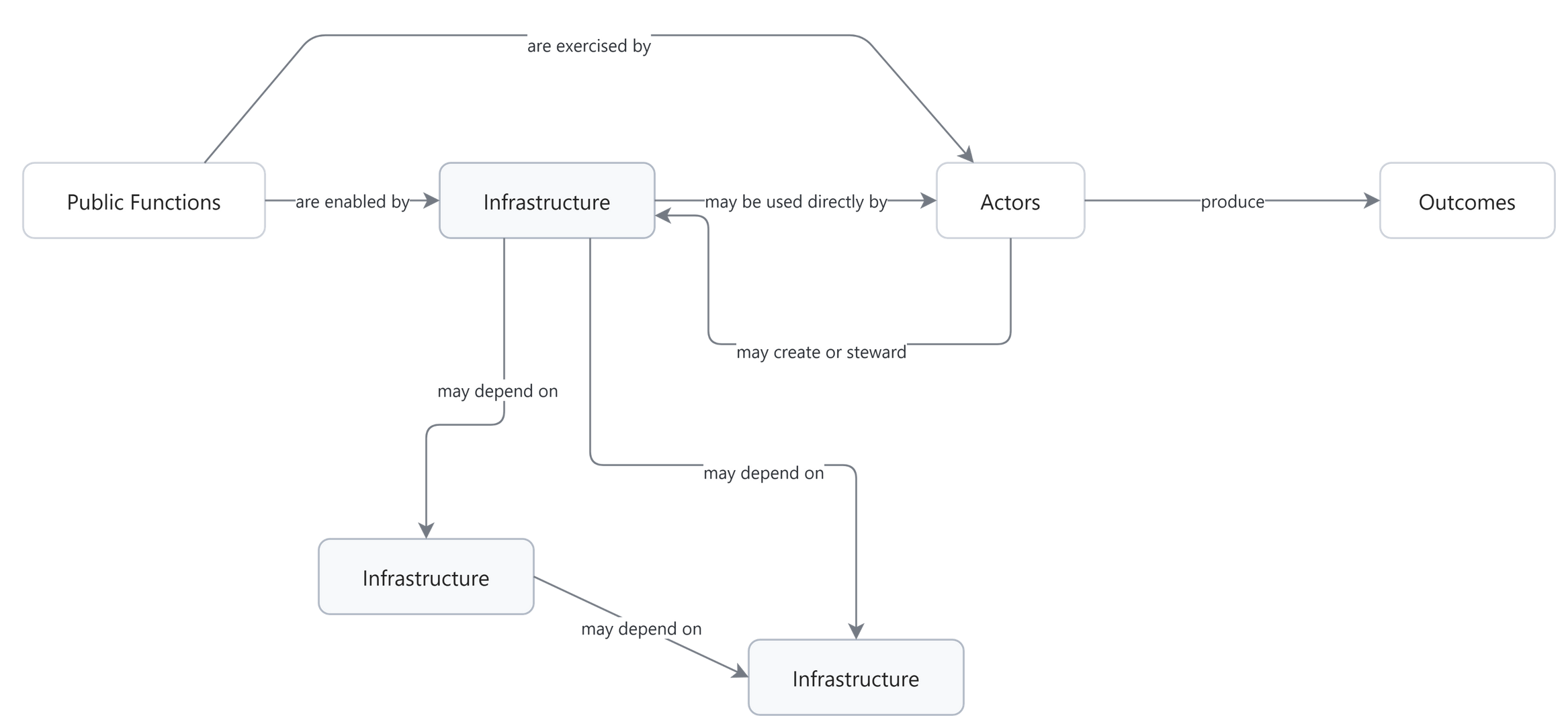
Infrastructure is a shared system or established arrangement that enables actors to exercise a public function. It serves actors in multiple independent projects and institutions. Infrastructure may take technical, institutional, social, or cultural forms. Technical forms include protocols, standards, implementations, networks, registries, repositories, services, archives, and preservation systems. Other forms include governance arrangements, shared vocabularies, credentialing systems, correction practices, and communities that sustain standards.
Infrastructure mediates the enabling relationship introduced in Section 2. Actors create, maintain, operate, steward, or improve infrastructure, and that infrastructure enables public functions. Actors also rely on infrastructure when they exercise those functions. The same actor may work on infrastructure and also rely on infrastructure to exercise a function. Infrastructure also depends on other infrastructure, and those dependencies form graphs. One system is deeper only in relation to another system that depends on the first system.
Example
In the Research Infrastructure domain, retrieving and inspecting a research object may rely on a repository service, shared metadata and vocabulary, network protocols, naming systems, storage, preservation arrangements, and the communities that maintain the relevant standards. Each system or arrangement supplies a distinguishable part of the function, and each may have different stewards, alternatives, or failure conditions.
An identifier-resolution service for research objects may depend on a registry, naming and transport protocols, persistent stewardship of its namespace, and shared policies for updating records. The service enables identification only through that combined dependency graph.
Infrastructure work might include maintainers improving a resolution protocol, operators increasing a registry's capacity, and a standards community producing a more interoperable specification. Those changes are outcomes of infrastructure work, while the resulting systems and arrangements enable other actors to exercise public functions.
4. Applications
An application is a bounded tool, service, or product that provides an actor-facing interface and depends on infrastructure.
4.1 Direct and Application-Mediated Use
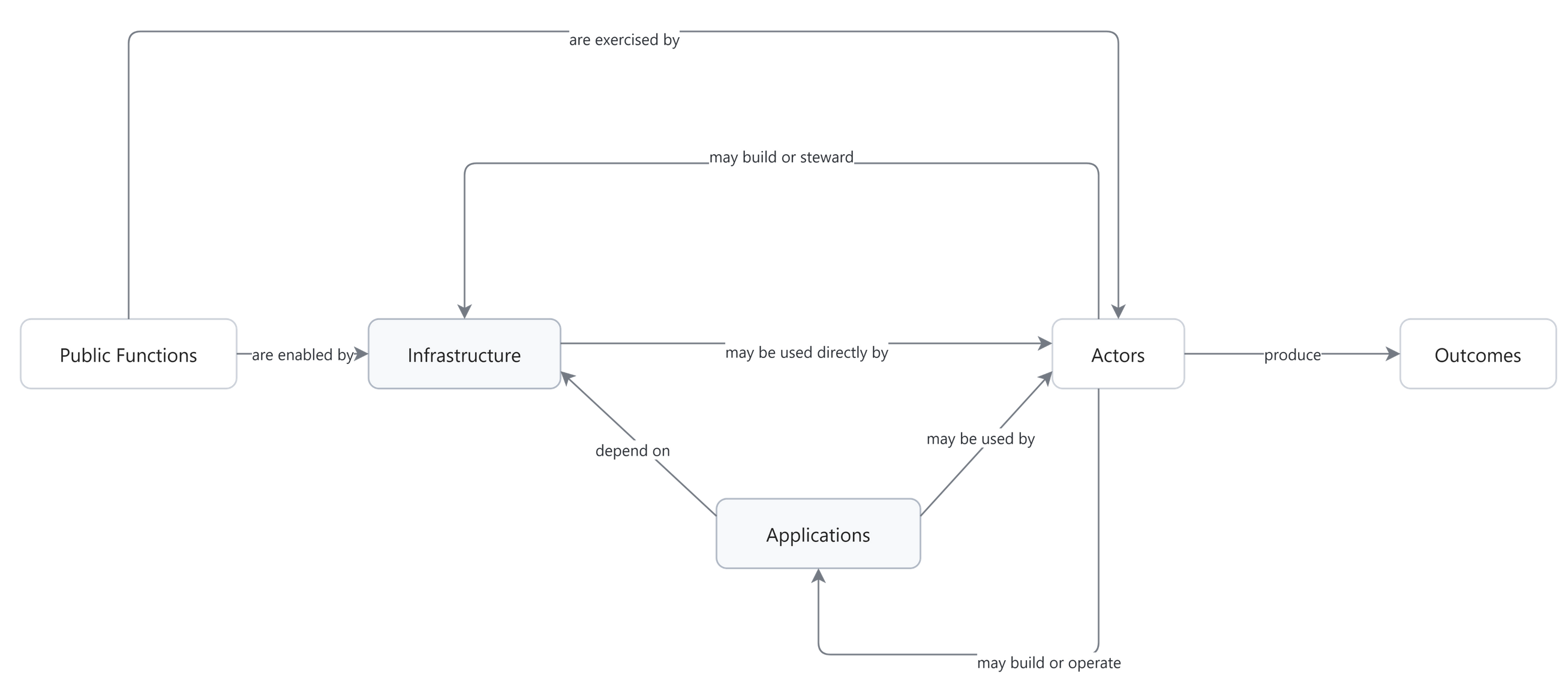
Actors may use infrastructure directly or through an application while exercising a public function. In either route, the infrastructure enables the function, the actor exercises it, and the actor may produce an outcome. The application mediates one route and always depends on infrastructure without directly enabling the underlying function.
Example
DOI registration and resolution can act as infrastructure by providing shared identifier, metadata, and resolution arrangements through which independently operated repositories and publishers keep research objects identifiable and resolvable. A repository’s deposit interface is an application that depends on this infrastructure when it registers and presents a research object. Other repositories, indexing services, citation managers, and AI systems can register or resolve DOIs and query their metadata without using that deposit interface.
4.2 Applications in Outcome Production and Exposure
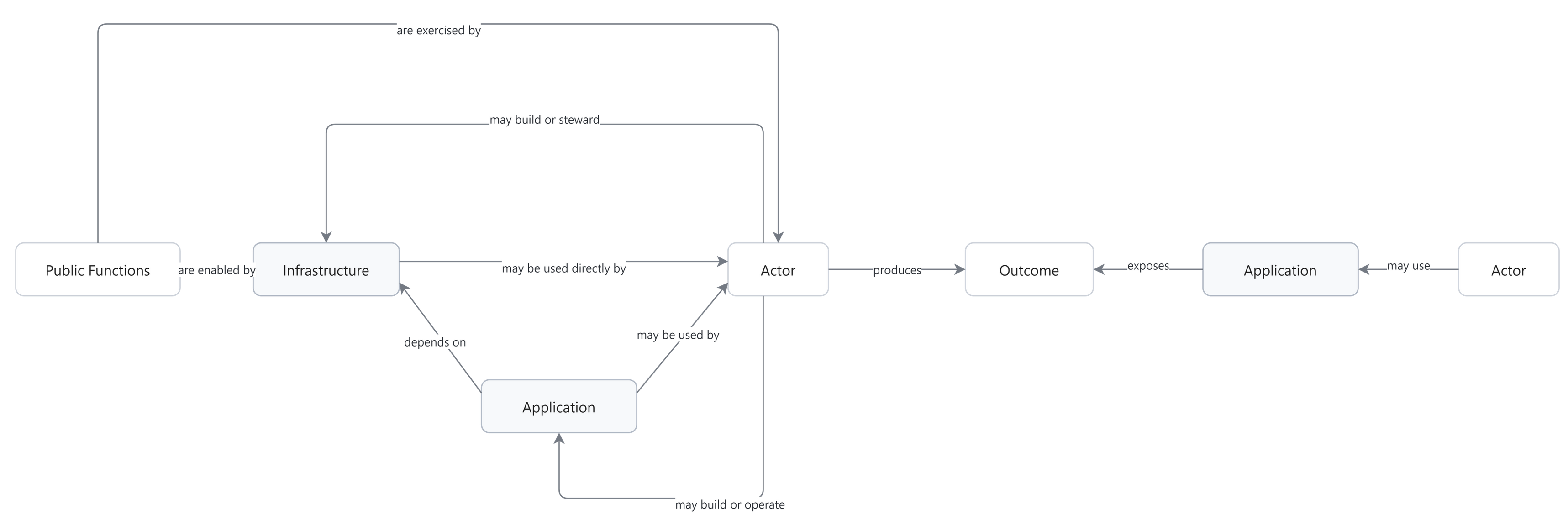
An application can play two roles relative to an outcome. An actor may use an application while producing an outcome. An application may also expose an existing outcome by making it accessible, observable, or usable to another actor. The same application may perform both the production role and the exposure role.
Example
A repository interface might help one researcher deposit a dataset. Later, the same interface might help another researcher find and inspect that dataset. The first researcher produces the dataset while using the interface. The interface subsequently exposes that dataset to the second researcher. In both cases, the application depends on storage, identifier, metadata, and preservation infrastructure. A browser may similarly expose a published finding while using HTTP as the transfer protocol.
4.3 Machine Actors and Interfaces

AI systems and agents are actors. They can often interact with infrastructure directly through protocols and APIs without using the human-facing applications built on top of that infrastructure. This is usually the more efficient route because the AI can exchange structured data and invoke capabilities directly.
Applications primarily make infrastructure usable to people, but they may also provide machine-facing interfaces. An API or MCP server can let an AI system use an application’s data or capabilities without navigating its visual interface. Skills and workflows can then instruct the AI system how and when to use those interfaces. Through either route, the AI ultimately depends on the underlying infrastructure.
Example
An AI agent preparing a literature review receives a list of DOIs. It queries Crossref’s API directly to retrieve citation metadata from DOI infrastructure, then uses Zotero’s API to add selected papers to a shared library. A researcher performs the second step through Zotero’s human-facing interface. A Skill could instruct the agent how to query Crossref, validate the returned records, and add approved citations to Zotero.
5. The Core's Role in the Domain System
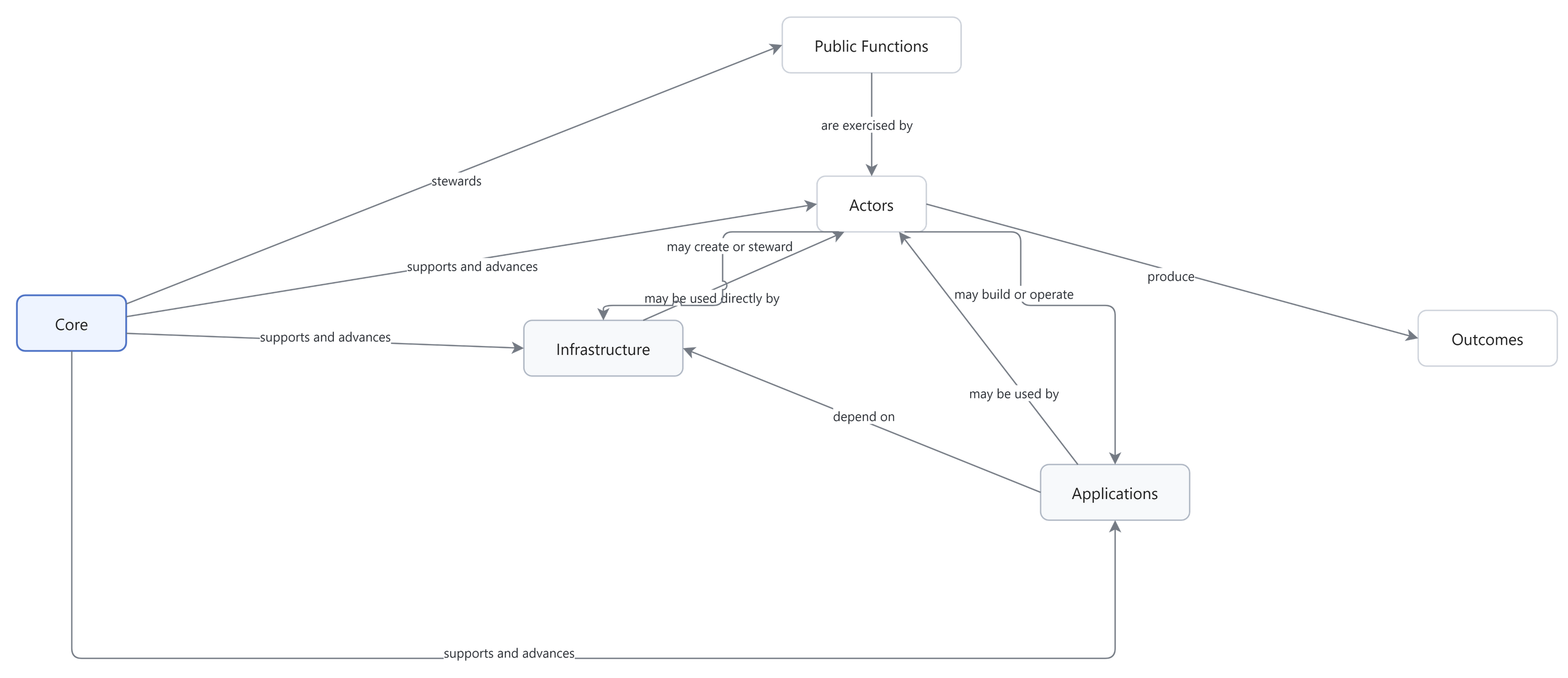
The Core stewards each public function required by its mission. Stewardship can preserve continuity, increase capacity, extend reach, improve quality or reliability, and create capabilities that make new outcomes practical.
The Core's stewardship supports actors who exercise public functions and actors who create, maintain, operate, steward, or improve the infrastructure that enables them, and the applications that depend on the infrastructure. Support is a broad relationship at this stage of the model. A Core may pay, commission, appoint, coordinate, recognize, incubate, negotiate, or remove barriers. It may support infrastructure without owning that infrastructure and support applications without governing those applications.
Example
The Research Infrastructure Core continuously assesses which contemporary infrastructure enables its mission's required public functions, the dependencies of that infrastructure, where it is fragile or missing, and where missing infrastructure capabilities limit actors' ability to exercise a function or expose an outcome. It can support maintainers, operators, researchers, application owners, institutions, communities, and other actors whose work addresses those conditions.
The Core may also assume responsibility for selected infrastructure and appoint paid stewards. Direct infrastructure stewardship is one possible relationship between the Core and infrastructure. The Core still stewards the required public functions when the relevant infrastructure remains independently owned and operated.
Part I Cumulative Model
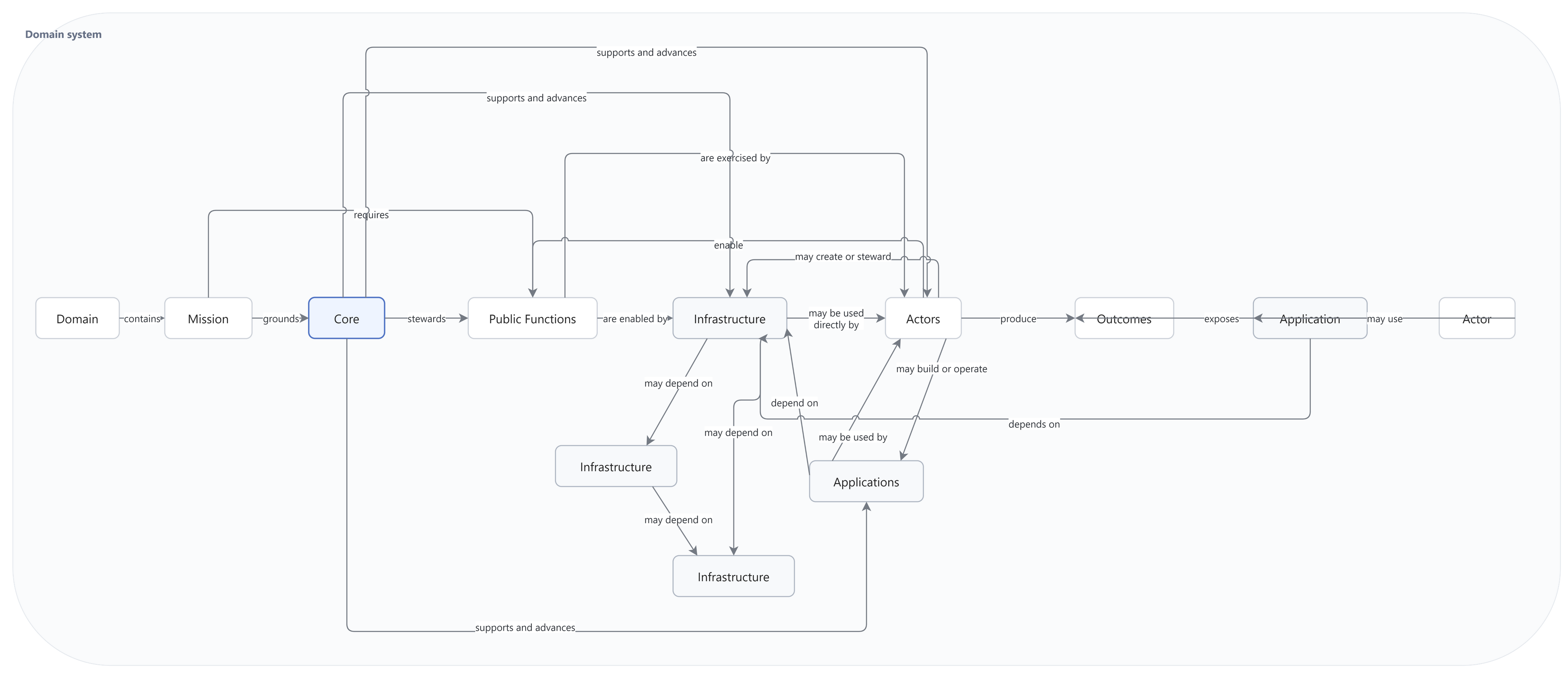
The domain contains the mission, the mission grounds the Core, and the Core stewards the mission's required public functions. Actors engage with those functions in two overlapping roles. They exercise public functions, or they create, maintain, operate, steward, or improve the infrastructure that enables those functions. Exercising a function and working on infrastructure both produce outcomes. Actors, including AI systems and agents, may use infrastructure directly or through an application. Actors may build or operate applications; they may use an application while producing an outcome, and an application may expose an existing outcome to another actor.
Part II. The Expression of Expertise
A Core is a body of experts with detailed, current knowledge of its domain. That expertise remains embodied in its members and develops through continuing practice. Members bring that embodied expertise into the Core's deliberation. When the Core authorizes a conclusion through its governing processes, it becomes collective judgment.
The Core expresses its collective judgment by answering the questions about its domain that fall within its mission and expertise. The following sections detail a non-exhaustive list of possible approaches to common questions. Each Core independently determines which questions to ask and how to ask those questions.
6. Identifying Critical Infrastructure
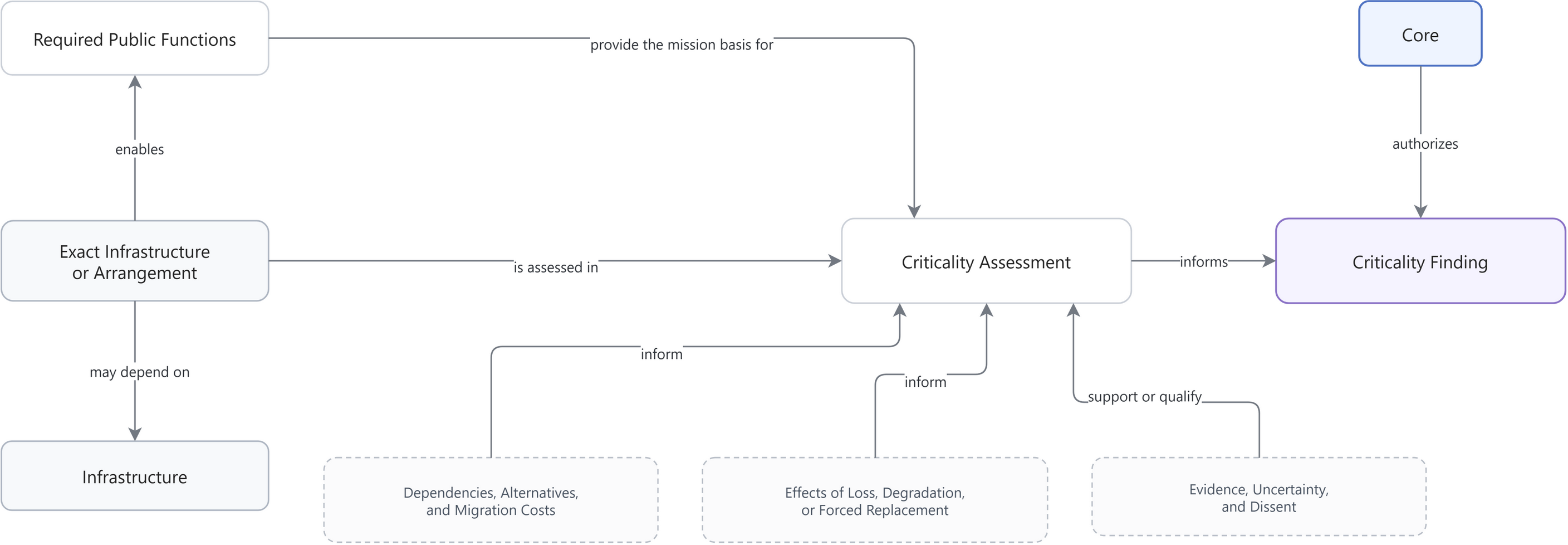
The Core identifies which exact infrastructure is critical for expression of its stewarded public functions. Each Core defines and publishes the criteria by which it identifies infrastructure as critical in relation to its mission and required public functions.
Each identification applies the Core's published criteria to a stated infrastructure subject and records enough information about its scope, basis, evidence, uncertainty, and dissent to make the judgment inspectable and revisable.
Criticality is distinct from infrastructure condition, stewardship suitability, and a decision to provide support. Infrastructure can be critical while it is healthy or fragile, and while its stewardship arrangement is capable, under-resourced, extractive, or illegitimate. The Core assesses criticality, infrastructure condition, stewardship suitability, and the decision to provide support as separate questions. Identifying infrastructure as critical does not commit the Core to funding, operating, replacing, or otherwise intervening in that infrastructure.
Example
The Research Infrastructure Core first asks which existing infrastructure is critical to making and keeping research identifiable, attributable, discoverable, inspectable, executable where applicable, correctable, and preservable. It might identify an exact identifier registry as critical because losing it would interrupt resolution across independently operated systems. That finding would establish the registry's importance without yet establishing its condition, the suitability of its stewardship, or whether the Core should act.
7. Assessing Infrastructure Condition and Stewardship
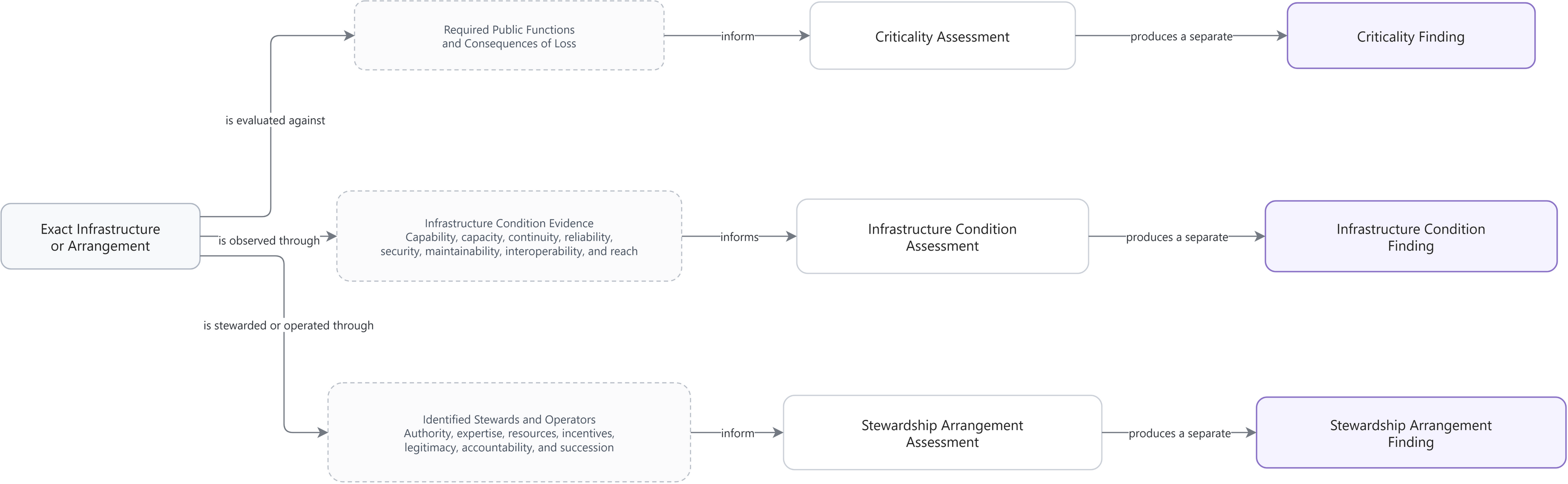
The Core assesses the present condition and likely trajectory of infrastructure and the arrangement through which it is stewarded and operated. Together, the condition and stewardship judgments describe infrastructure health.
An infrastructure condition assessment applies criteria defined by the Core to a stated system or arrangement in relation to its associated public functions. It records the assessment's scope, evidence, limitations, present conclusion, and likely trajectory.
A stewardship assessment concerns the relationship between that infrastructure and its responsible actors. An operator carries out the day-to-day work through which a system or arrangement functions. A steward holds continuing responsibility for its direction, continuity, and governance. One actor may perform both the operator role and the steward role.
Example
The Research Infrastructure Core might find that a critical identifier service is technically reliable but operating near capacity, while its capable steward lacks durable funding and succession plans. It might instead find technically healthy infrastructure governed through an extractive or illegitimate arrangement. The first condition could support strengthening the existing steward; the second could support governance change, portability, redundancy, migration, or an alternative.
8. Identifying Mission-Relevant Applications
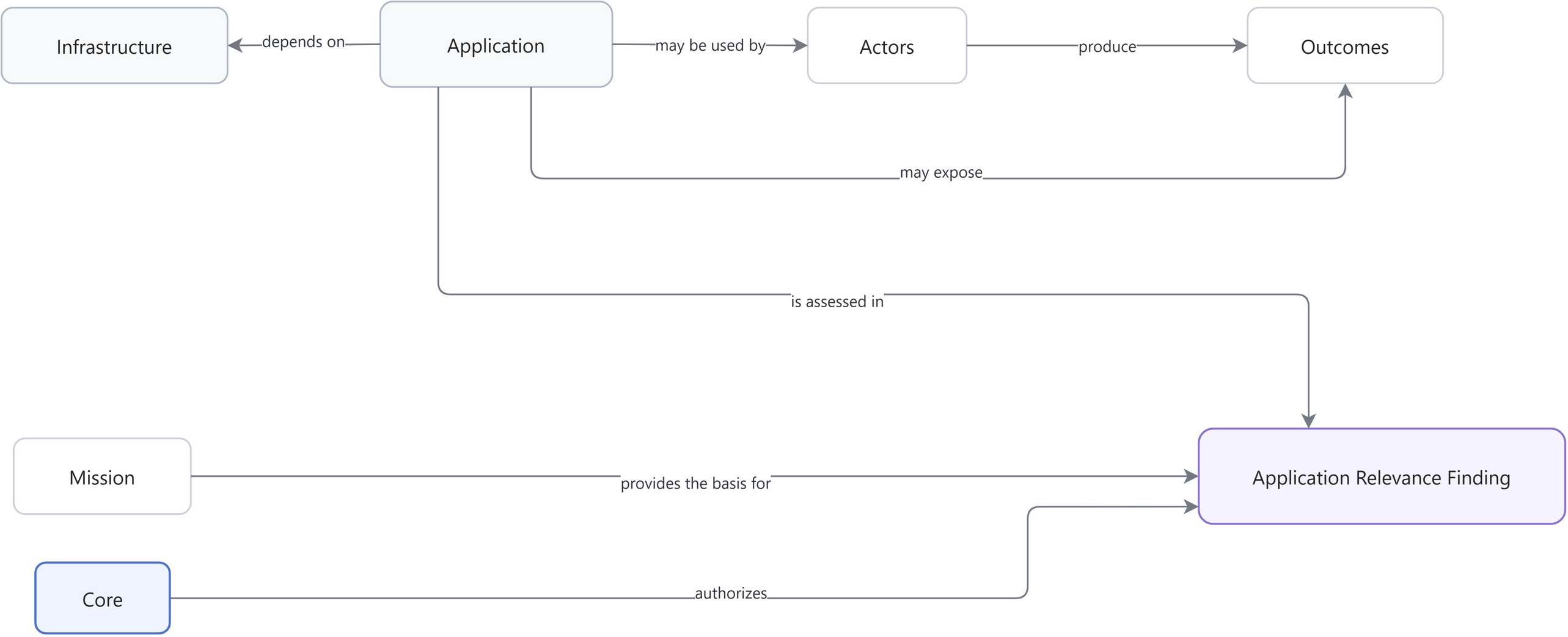
The Core identifies applications that contribute to its mission by helping actors produce outcomes or by exposing existing outcomes to other actors. Each identification applies the Core's criteria to a stated application and records enough information about its role, evidence, scope, and limitations to make the finding inspectable and revisable.
Mission relevance does not make an application infrastructure, establish that it is critical, or commit the Core to supporting that application. The finding describes the application's role in the domain system.
Example
The Research Infrastructure Core might identify a repository application as mission-relevant because researchers use it to deposit attributable datasets and other actors use it to find and inspect those datasets. The application depends on storage systems, identifier systems, metadata standards, network protocols, and preservation arrangements. Its interface advances the mission without itself supplying every underlying public function.
9. Mapping Dependencies
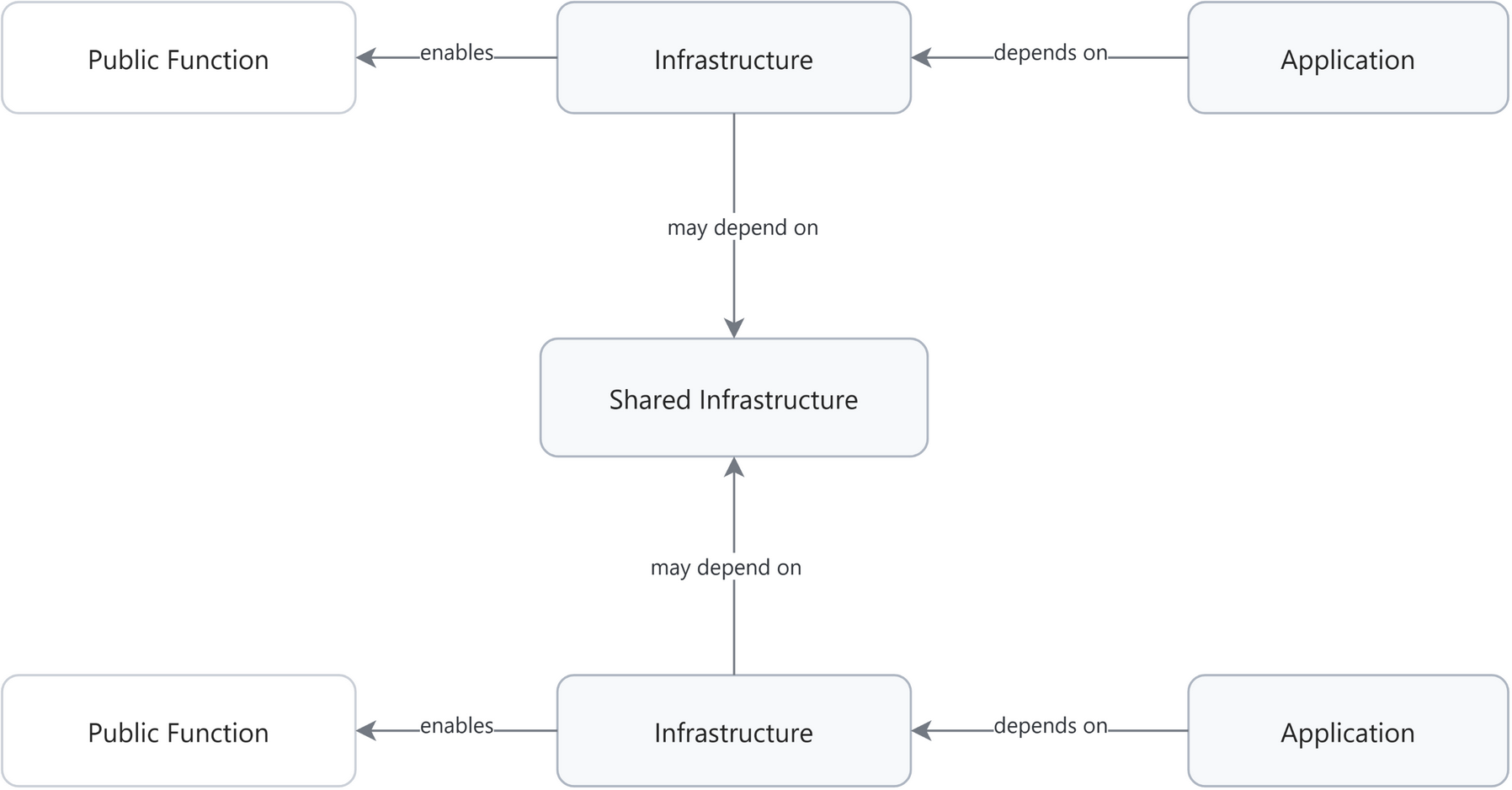
The Core maps the dependencies material to its mission using relationship types, scope, identification rules, versioning rules, and representations that it defines and publishes.
Dependency mapping reveals shared dependencies, concentrations of reliance, correlated failure risks, limited substitution options, and migration paths. It can expose the importance of infrastructure that is less visible than its dependent applications and services.
Example
An identifier-resolution service may depend on a registry, naming and transport protocols, stewardship of its namespace, and shared policies for updating records. Repository applications, preservation services, and research workflows may all depend on that resolution service. Mapping the complete chain reveals where several visible systems rely on the same underlying infrastructure.
10. Identifying Domain Gaps
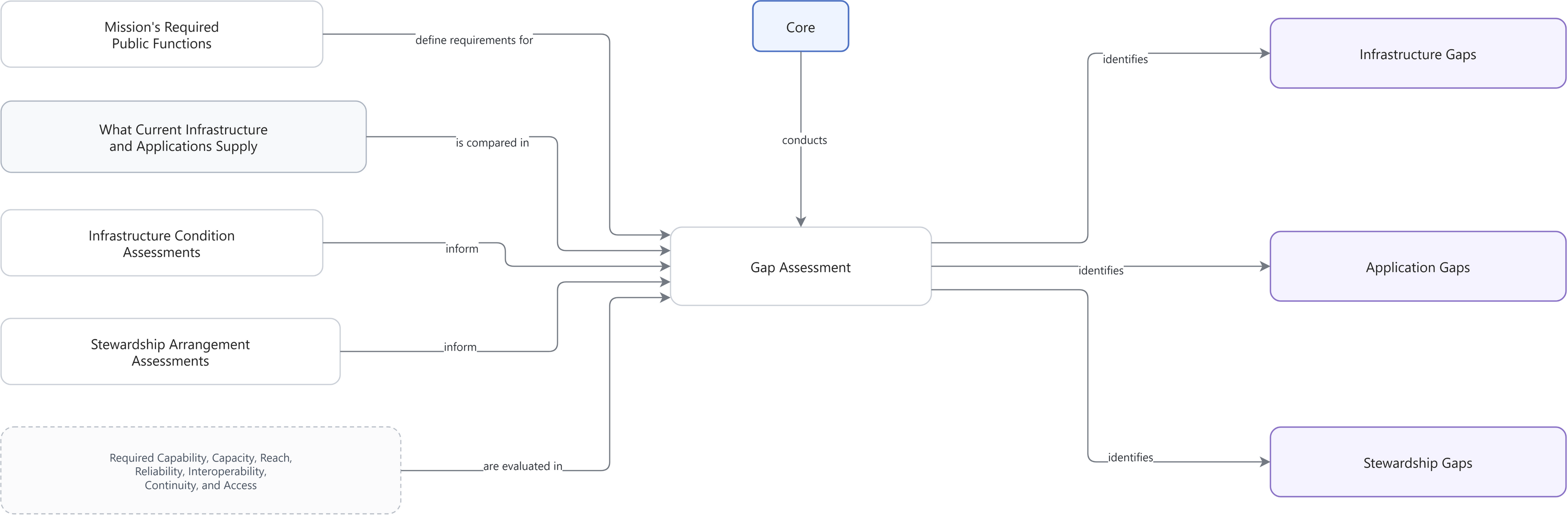
The Core compares what its mission requires from the domain's public functions with what existing infrastructure, applications, and stewardship currently supply. Condition and stewardship assessments provide evidence about the present supply. A gap may be an absence or another shortfall under the Core's published gap criteria.
Each Core defines and publishes the categories of domain gaps it recognizes and the conditions under which each category applies.
Example
The Research Infrastructure Core might find that repositories and preservation standards exist but do not publish correction and retraction information in a consistent machine-readable form. That could constitute an infrastructure gap if systems cannot reliably exchange the information, an application gap if researchers cannot see or act on it, and a stewardship gap if no durable body maintains the shared arrangement.
11. Expressing Trust Signals
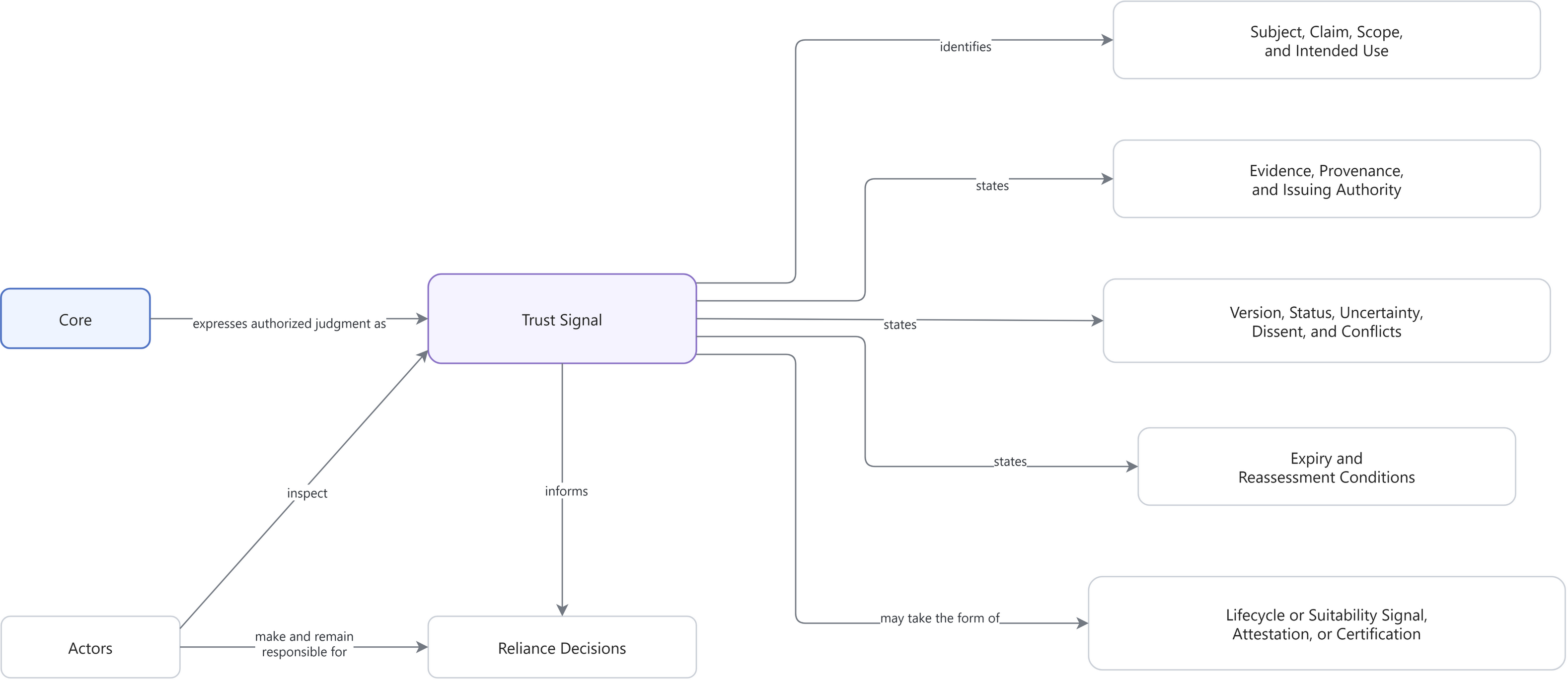
A trust signal is a structured expression of an authorized Core judgment. It helps an actor decide whether and how to rely on an exact subject for a stated use. That expression of judgment is scoped, evidence-backed, and versioned. It is not a general declaration that the subject is good, safe, worthy, or endorsed for every purpose.
Each signal identifies the exact subject and version, the claim being made, its scope or intended use, supporting evidence, the person or body responsible for the claim and its provenance, date and current status, material uncertainty, dissent or conflicts, and conditions for expiration or reassessment. Lifecycle and suitability signals, attestations, and certifications are possible forms.
A criticality finding is distinct from a trust signal. Neither an infrastructure condition assessment nor a stewardship assessment automatically becomes a trust signal. Those assessments describe current conditions; a trust signal draws a scoped conclusion about whether and how an actor may rely on an exact subject for a stated use. Infrastructure can be critical while its current condition or stewardship arrangement makes reliance inappropriate. A trust signal also does not imply that the Core owns, operates, or guarantees its subject.
Example
The Research Infrastructure Core might certify that a dataset meets named provenance and preservation criteria for a specified use, state that another dataset should be excluded from a particular synthesis because it has been retracted or is incompatible with the stated method, or attest that a workflow was tested against named versions and evaluation data. A person or AI system can inspect the signal's scope, evidence, limitations, and reassessment date while remaining responsible for the resulting reliance decision.
12. The Domain Knowledge Map
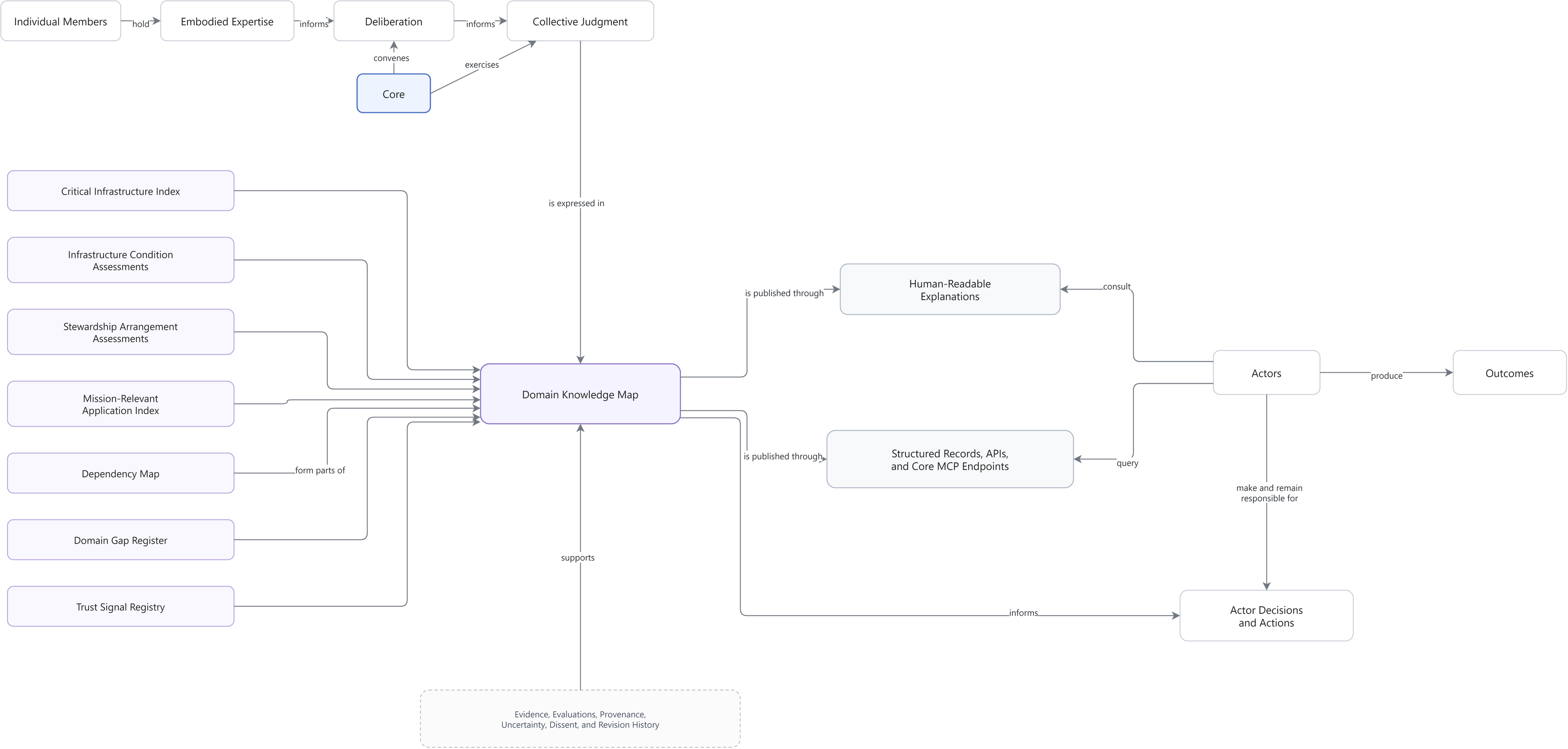
The Domain Knowledge Map is the versioned public interface through which the Core publishes its authorized answers about the domain. The map records exact objects, relationships, assessments, and changes.
Each Core specifies which authorized records and knowledge products its Domain Knowledge Map integrates. Every component is supported by evidence, evaluation methods, provenance, uncertainty, dissent, and revision history. The map is the Core's inspectable and revisable public expression of what it currently knows and concludes.
Actors can consult or query the map without becoming members, receiving Core support, or entering a funding relationship. Human-readable explanations and structured records, APIs, or Core-operated MCP endpoints provide different interfaces to the same authorized content. The Core identifies subjects at the level of specificity required to keep findings attributable to what was actually assessed.
Example
The Research Infrastructure Knowledge Map would let researchers, maintainers, funders, application builders, institutions, and AI systems inspect which infrastructure the Core identifies as critical, what condition it is in, how its operation and stewardship are arranged, which applications it finds mission-relevant, how those objects depend on one another, where gaps exist, and which scoped trust signals apply. Actors could use the same underlying knowledge when choosing a dataset, designing a synthesis, maintaining a dependency, building an application, coordinating work, or deciding what to support.
Part III. Mobilizing Capacity
The Core mobilizes capacity through authorized decisions, support relationships, and accountable commitments.
13. Capacity and Target Selection
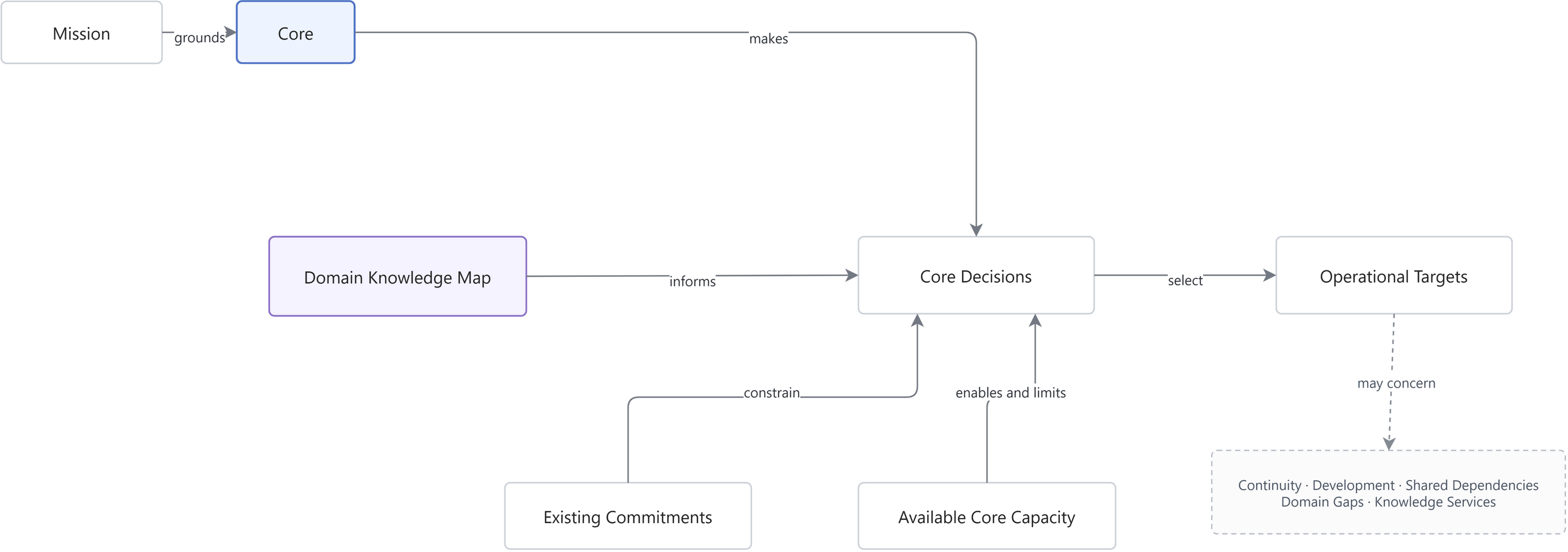
A Core's operational capacity consists of the resources, time, authority, relationships, systems, and practical capabilities it can legitimately direct. The form of that operational capacity differs among Cores. It may include discretionary funds, expert time committed to Core work, staff or steward capacity, administrative and contracting capabilities, coordination capabilities, convening power, and authority over infrastructure already within the Core. Existing responsibilities and commitments consume a Core's operational capacity.
The Core uses its mission, Domain Knowledge Map, existing commitments, and available capacity to select operational targets. The domain-specific findings and assessments the Core has defined supply evidence for that decision. A target is a defined condition in the domain that the Core decides to maintain, improve, create, or change. It may concern any mission-relevant condition, relationship, artifact, or knowledge service within the Core's authorized scope.
The Domain Knowledge Map may identify far more needs than the Core can address. No conclusion or assessment recorded in the map commits the Core to acting on that conclusion or assessment. The Core creates a commitment only through a separately authorized decision that defines what it will pursue and what capacity it will direct.
Example
The Research Infrastructure Core might identify critical identifier, repository, preservation, and execution systems, assess their technical condition and stewardship arrangements, and identify application and domain gaps across those systems. Given its present capacity, it might select continuity of identifier resolution and machine-actionable provenance as immediate operational targets. Other critical or unhealthy conditions would remain visible in the Domain Knowledge Map without becoming current Core commitments.
14. Support Channels
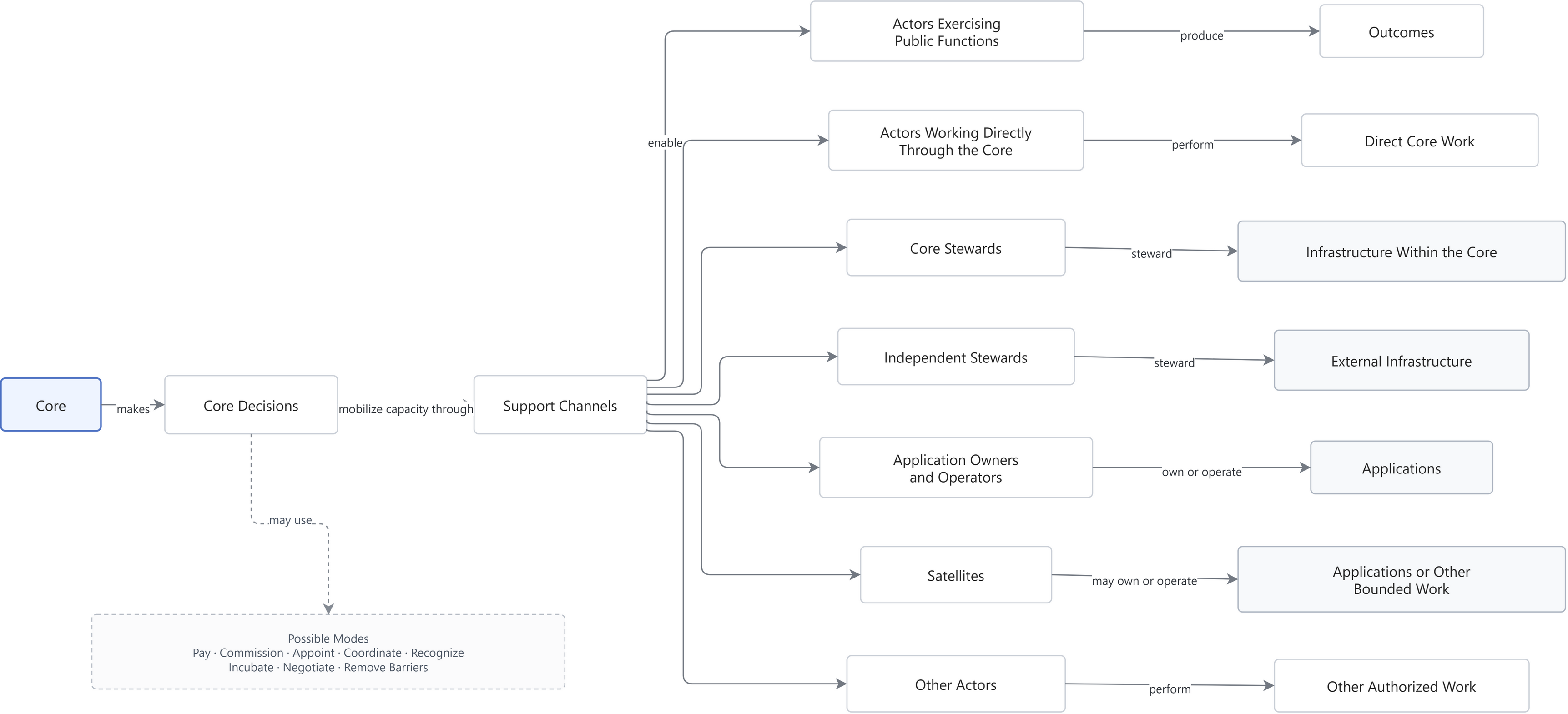
After selecting a target, the Core chooses the channel through which it will act. A support channel identifies where responsibility sits and through which actors the Core mobilizes capacity.
The Core may enable actors to exercise public functions and produce outcomes, perform work directly through actors working within or for it, appoint and pay Core stewards, support independent infrastructure stewards, work with application owners and operators, incubate or support infrastructure or applications, or engage other actors appropriate to the target. It may pay, commission, appoint, coordinate, recognize, incubate, negotiate, or remove barriers. These possible channels and actions are neither exhaustive nor mutually exclusive.
Independent stewards of external infrastructure retain responsibility for that infrastructure. Application owners and operators retain ownership and operating responsibility. The Core assumes responsibility for infrastructure or another artifact only through a separate explicit decision supported by the authority and capacity needed to carry that responsibility.
Support may preserve continuity or advance capability, capacity, reach, quality, reliability, or accessibility. The actors enabled through a support channel remain responsible for their work and the outcomes they produce. The Core remains accountable for selecting the channel, establishing its terms, and fulfilling its own commitments.
Example
The Research Infrastructure Core might identify continuity of dataset identification as an operational target because a widely used repository’s DOI-registration integration is failing. The Core funds the repository’s independent operator to repair and maintain the integration without assuming responsibility for the repository. The operator remains responsible for the service; the Core remains accountable for selecting the target, setting the terms of support, and fulfilling its commitment.
15. Turning a Funder's Desired Outcome into Domain Action
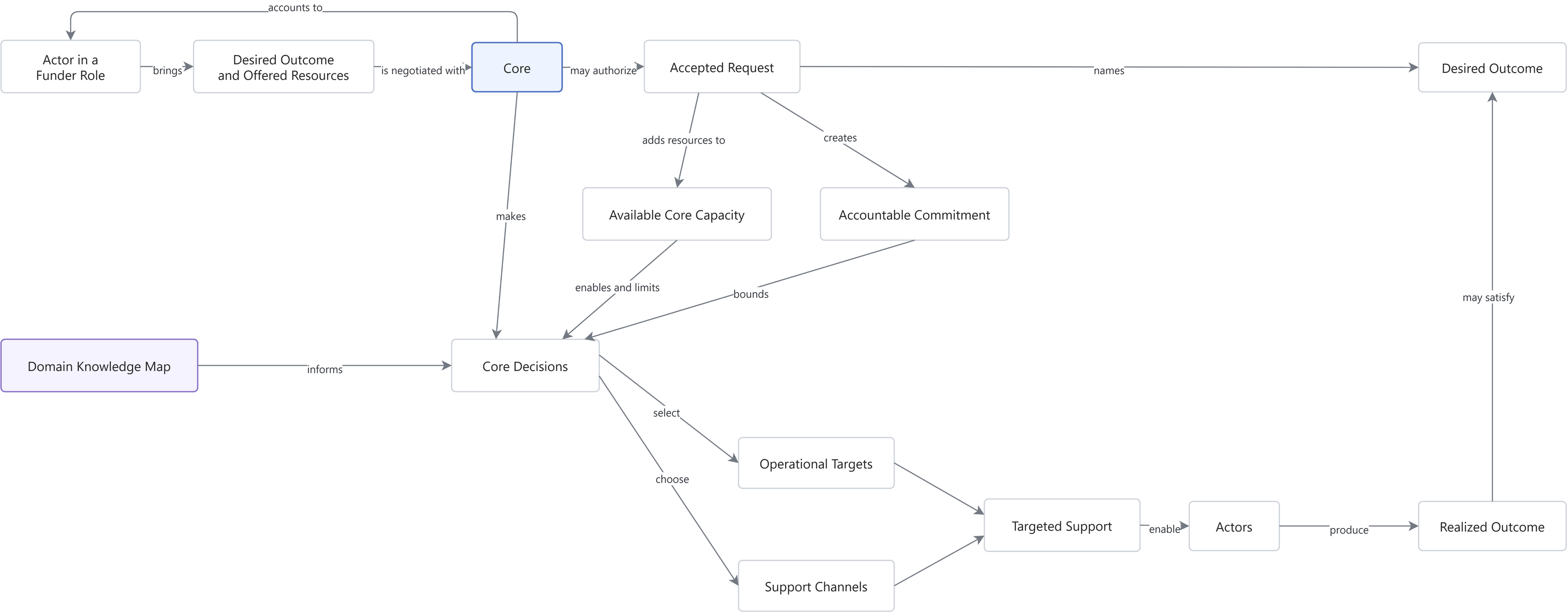
A funder is an actor occupying a resource-providing role. It brings the Core a desired outcome related to the domain and resources it is prepared to provide. The funder defines what it wants to accomplish; it does not automatically determine which projects, infrastructure, applications, or recipients should receive support.
The Core evaluates and negotiates the request through its combined expertise, Domain Knowledge Map, current capacity, and governing rules. It may accept, revise, or reject the funder's request. An accepted request both increases available capacity and creates an accountable commitment to pursue the agreed outcome.
The Core then determines the route through the domain to achieve the desired outcome. It selects the operational targets implicated by the outcome and chooses the actors and support channels through which to pursue those targets. Most accepted resources may be directed toward work closely connected to the desired outcome, while other portions may sustain shared dependencies, Core operations, system-wide needs, or incubation required to make that work possible. Each Core sets out the details of its own operational structure.
The Core accounts to the funder for its decisions, commitments, and use of accepted resources.
Example
A funder might ask the Research Infrastructure Core to make archived computational research reliably executable by a defined community. The Core could determine that this requires packaging standards, execution environments, preservation services, metadata, application interfaces, evaluation, and policy work. It could direct the accepted resources through several support channels while also sustaining shared dependencies required by the requested outcome.
Part III Cumulative Model
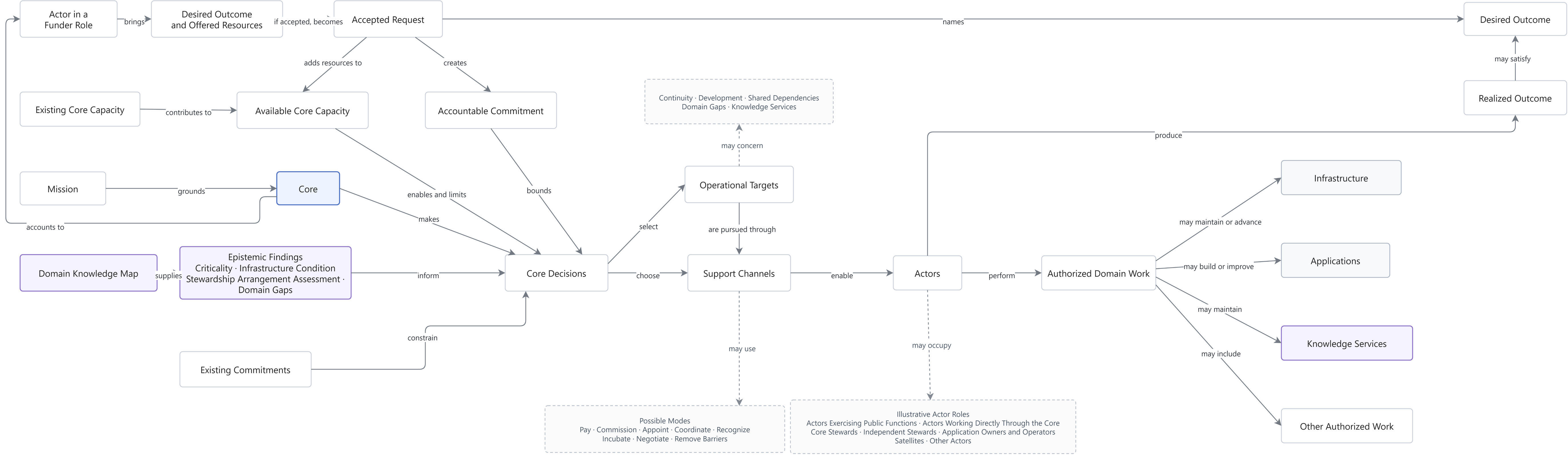
The Core combines its mission, Domain Knowledge Map, existing commitments, and available capacity when making operational decisions. The domain-specific conclusions and assessments it has defined inform but do not determine those decisions. Those operational decisions select the Core's targets and support channels. Support channels mobilize capacity through actors who exercise public functions to produce outcomes, maintain or advance infrastructure and applications, strengthen stewardship arrangements, provide knowledge services, or change other conditions in the domain while retaining responsibility for their work and outcomes.
A funder request adds resources to the Core's capacity and creates an accountable commitment to pursue an agreed outcome. The Core uses the same knowledge and decision processes to route that added capacity through the domain. It accounts to the funder without becoming a passive intermediary or allowing the requested outcome to dictate a project list.
Part IV. Inside the Core
The Core system is plural because each Core dictates its own internal operation and practices. Some likely commonalities across Cores are detailed in Part IV.
16. Members and Embodied Expertise
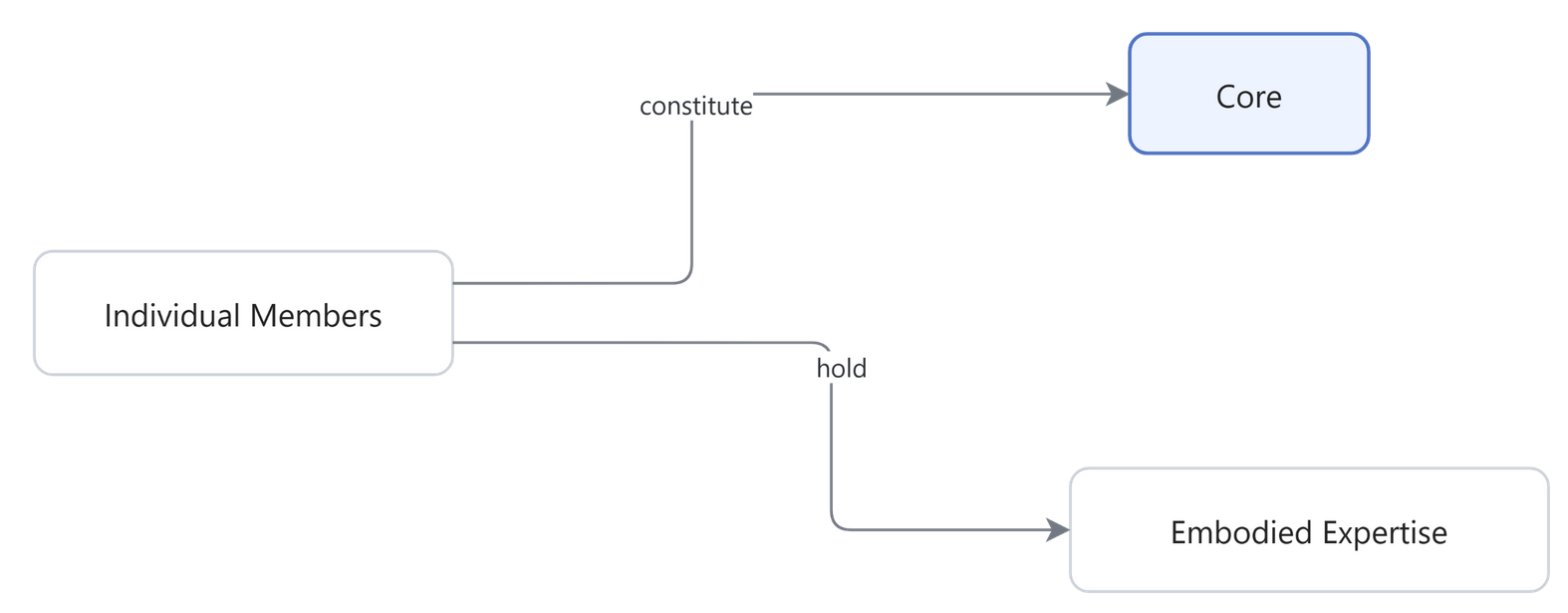
Membership belongs to people. Projects, organizations, and employers do not hold membership in a Core. Individual members participate in their own capacities and together constitute the Core. A Core is therefore an expert body and differs from a collection of member projects.
Example
The Research Infrastructure Core requires people who maintain and operate infrastructure because they remain close to its technical and operational conditions. It also requires researchers, application builders, business and operations professionals, governance and policy professionals, social researchers, community practitioners, and communications professionals.
Each perspective contributes different evidence and reasoning to the Core's shared questions about critical infrastructure, infrastructure condition, stewardship arrangements, mission-relevant applications, dependencies, gaps, trust, capacity, and action.
17. Continuing Practice and Current Expertise
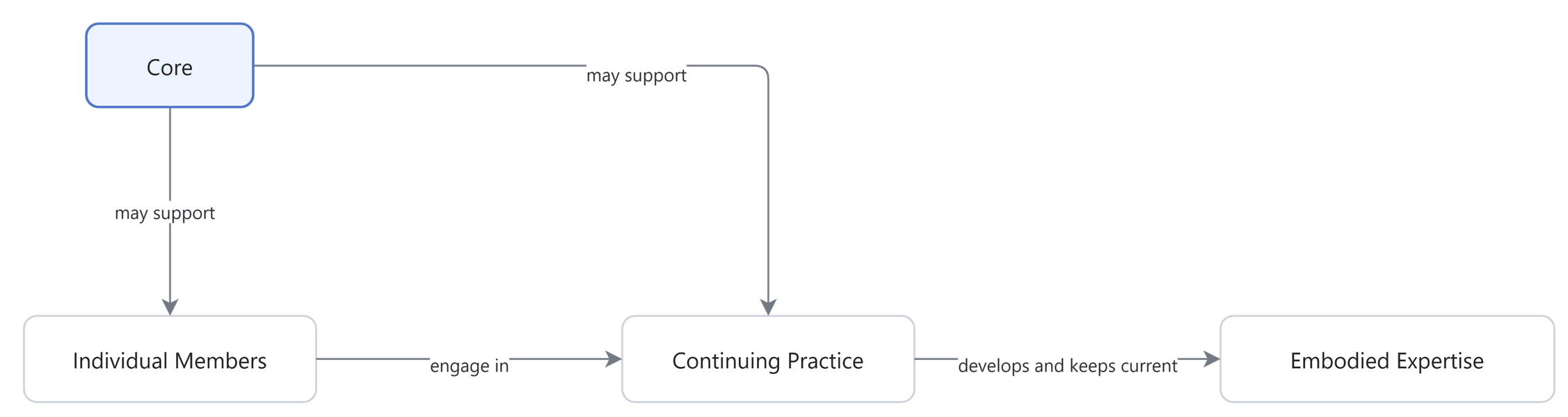
Members keep their expertise current through continuing practice inside or outside the Core. Practice connects judgment to the present domain conditions the Core has defined as relevant. A Core whose members no longer engage with those conditions will gradually lose the basis for its authority.
The Core may pay members for participation, judgment, and continuing practice. Paying an expert for expertise does not require the Core to acquire the expert's project or reduce the relationship to labor measured only by project output.
Example
For members of the Research Infrastructure Core, continuing practice may include maintenance, operations, research, application development, service delivery, business development, budgeting, policy, governance, community work, communication, or evaluation of human and machine interfaces.
A maintainer might continue reviewing changes to a protocol or implementation while contributing knowledge about dependencies and operational risk to Core deliberation. A researcher might continue using research infrastructure while testing whether the functions the Core claims to steward remain usable in practice.
18. Deliberation, Collective Judgment, and Dissent
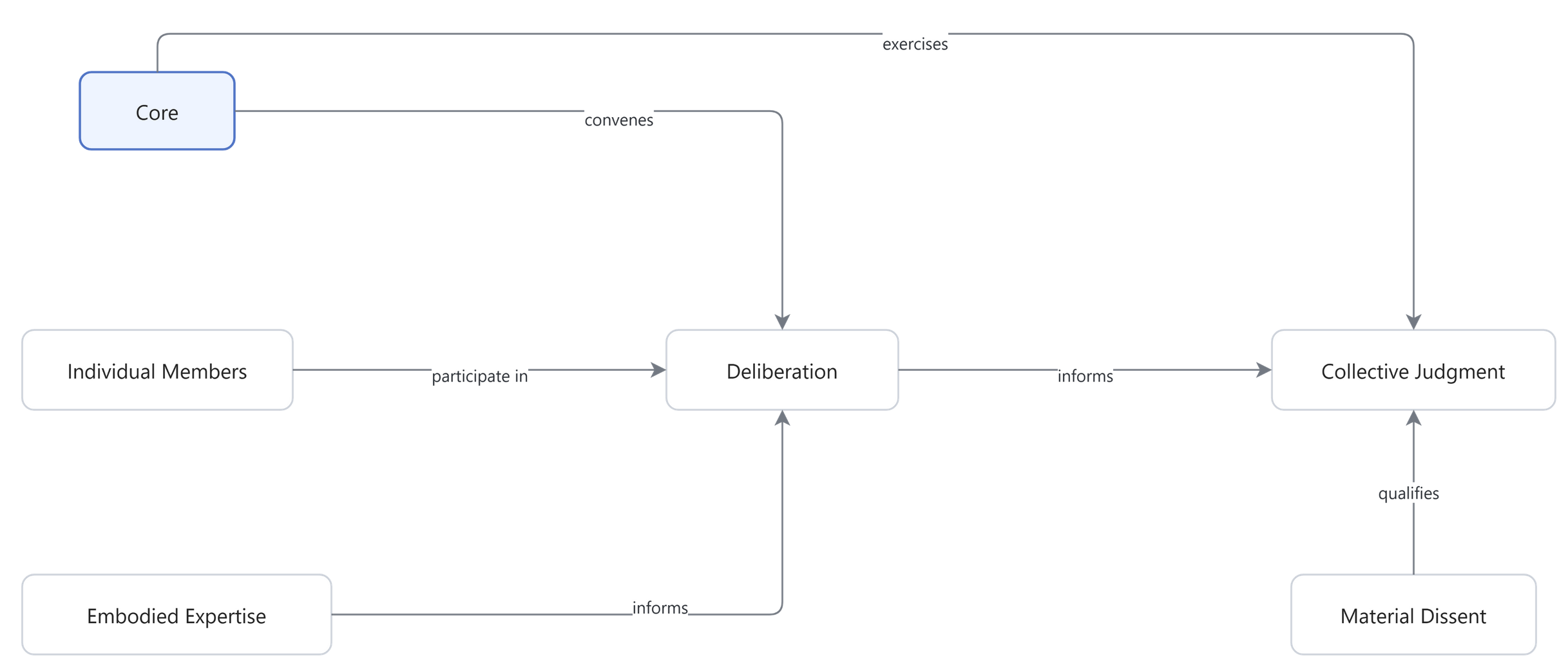
The Core convenes members to deliberate across disciplines and professions. Members bring their embodied expertise into that deliberative process. Deliberation informs the collective judgment the Core exercises, but no individual member's view becomes the Core's judgment without institutional authorization.
Collective judgment does not require unanimity among the Core's members. The Core may state an institutional conclusion while preserving material dissent, uncertainty, and the evidence on which competing conclusions rely.
Example
Maintainers, researchers, application builders, business practitioners, policy professionals, and affected communities may evaluate the same research infrastructure from different positions. Maintainers may know its actual failure modes, researchers may know which functions break in use, and governance specialists may identify authority or legitimacy problems.
The Research Infrastructure Core deliberates about criticality, infrastructure condition, stewardship arrangements, mission-relevant applications, dependencies, gaps, and trust signals. Its authorized epistemic conclusions enter the Domain Knowledge Map together with material dissent and uncertainty. Whether the Core will act is determined separately through the operational decisions described in Part III.
19. Authority, Governance, and Accountability
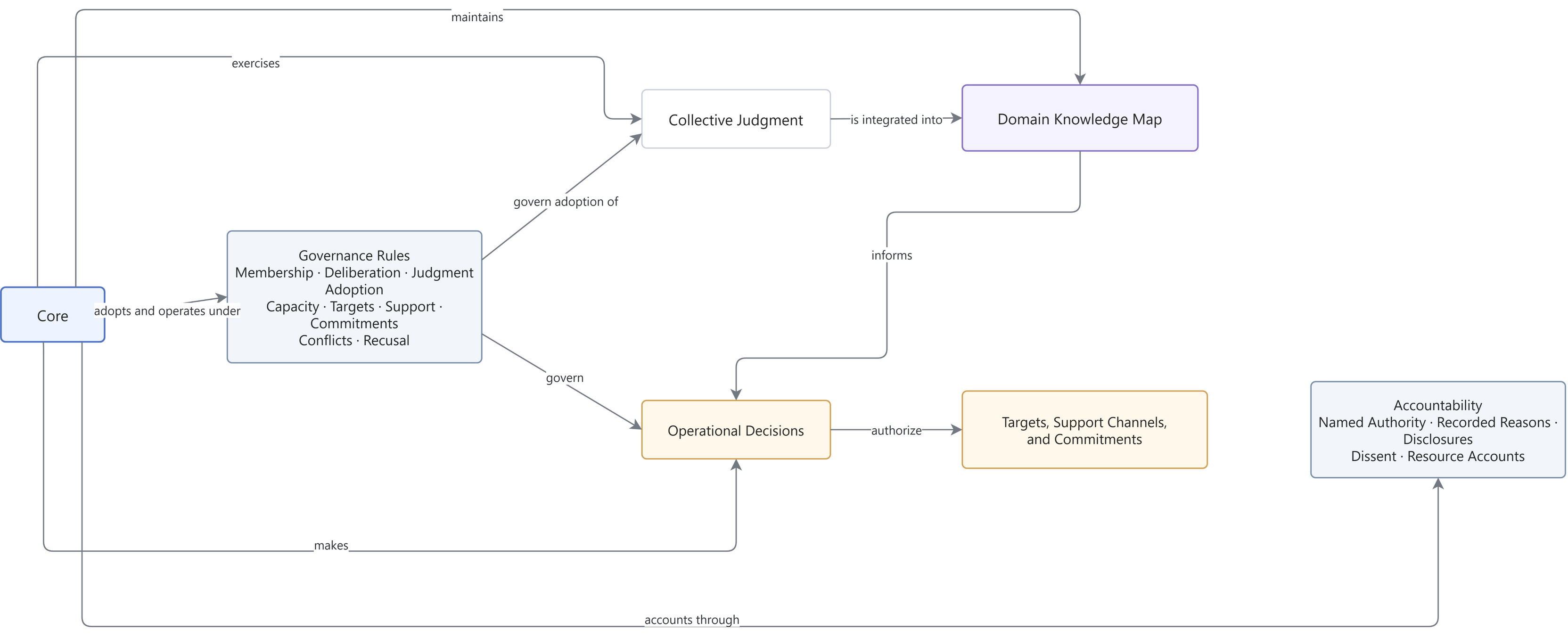
A Core needs explicit rules for membership, deliberation, adoption of collective judgment, maintenance of its Domain Knowledge Map, the domain-specific assessments it conducts, capacity assessment, target selection, support channels, acceptance of funder requests, resource commitments, conflicts of interest, and recusal. These rules identify who may act for the institution and how an authorized conclusion or decision differs from an individual's view.
The same rules govern both public expression of authorized conclusions in the Domain Knowledge Map and the commitments made through separately authorized operational decisions.
Part IV Cumulative Model
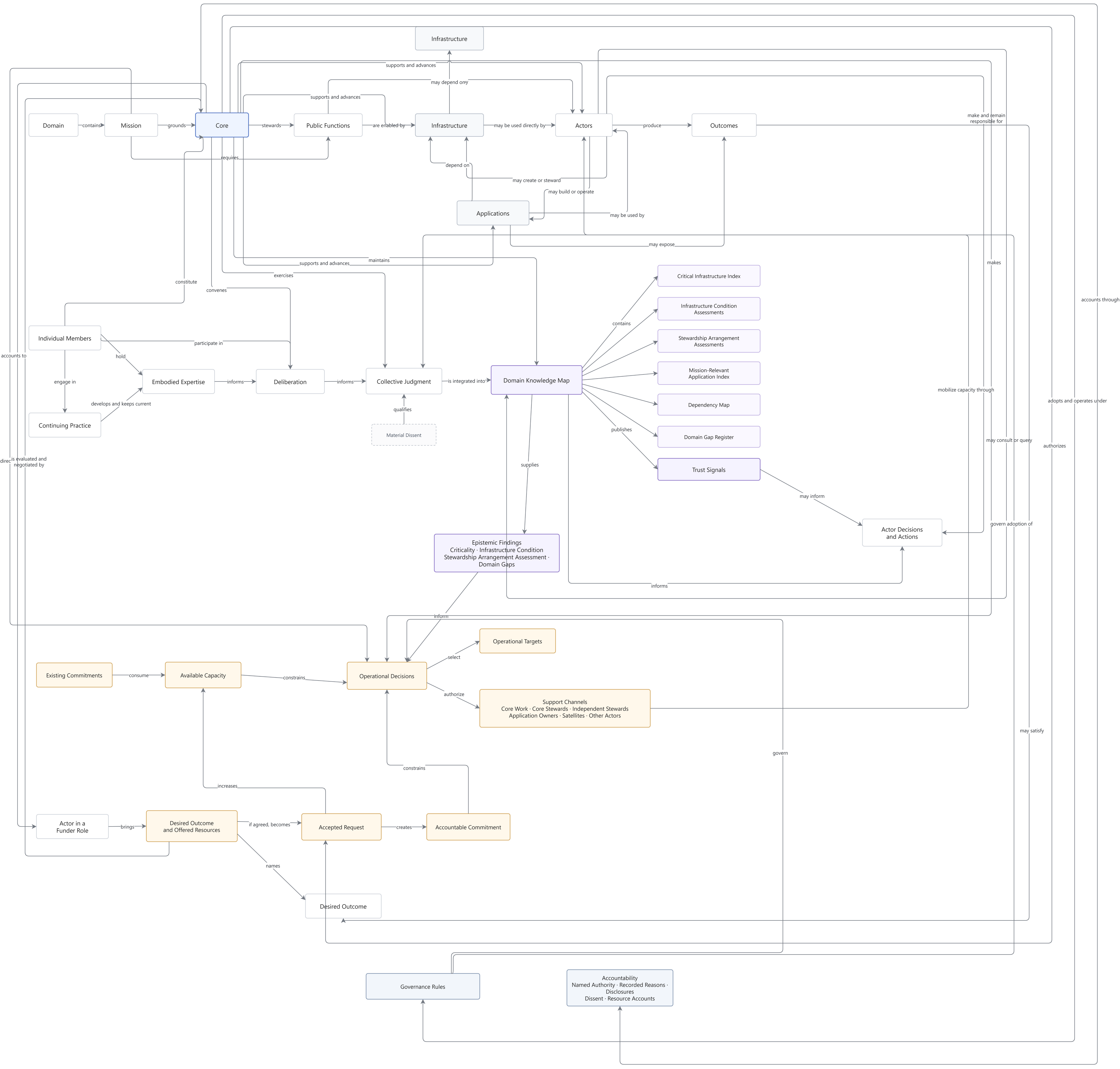
Individual members constitute the Core, maintain current embodied expertise through practice, and participate in deliberation. The Core exercises the collective judgment informed by that deliberation, expresses it in the Domain Knowledge Map, and uses it to inform separately authorized operational decisions.
The institution's rules govern how the Core authorizes its epistemic conclusions, maintains the Domain Knowledge Map, selects operational targets and support channels, accepts commitments, and accounts for its actions.
Part V. Change, Scale, and Multiple Cores
20. Evidence, Reassessment, and Change
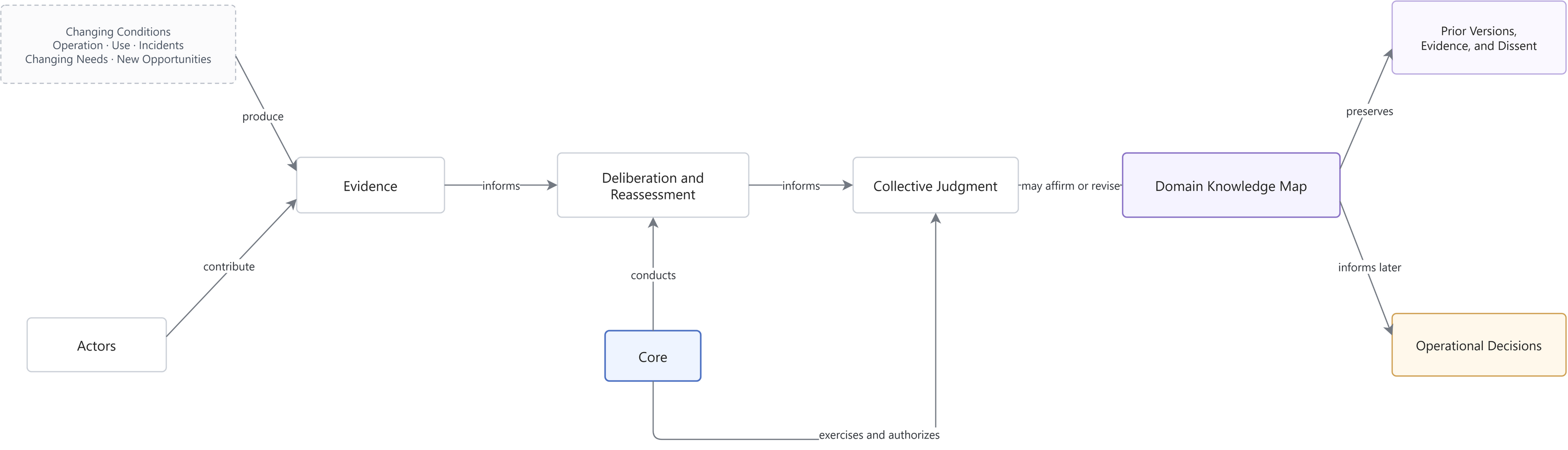
Public functions persist while the systems and arrangements that enable them change. Operation, use, incidents, changing needs, and new opportunities produce evidence about whether a function remains available and what its development requires. Actors can contribute evidence of that kind to the Core.
Each of the Core's conclusions is current and impermanent. New evidence may support, qualify, or challenge those conclusions. The Core reassesses the relevant question through its deliberative process, authorizes any change, and preserves the history needed to understand what changed and why. An external contribution can inform this process but cannot revise the Domain Knowledge Map on its own.
Each Core defines the kinds of evidence and changes in domain conditions relevant to reassessment and the dimensions on which its required public functions are judged.
A Core may respond to new evidence by affirming, revising, adding, or retiring an authorized conclusion or by making a separate operational decision. Any changed conclusion becomes a new authorized version of the relevant entry in the Domain Knowledge Map, while prior versions and material dissent remain available.
Example
The Research Infrastructure Core may respond by affirming its existing conclusion, revising a criticality finding, updating an infrastructure condition or stewardship assessment, changing a dependency relationship or trust signal, identifying a new gap, supporting maintenance, coordinating migration, increasing capacity, or supporting the creation of missing infrastructure.
21. Satellites, Accretion, and Responsibility Over Time
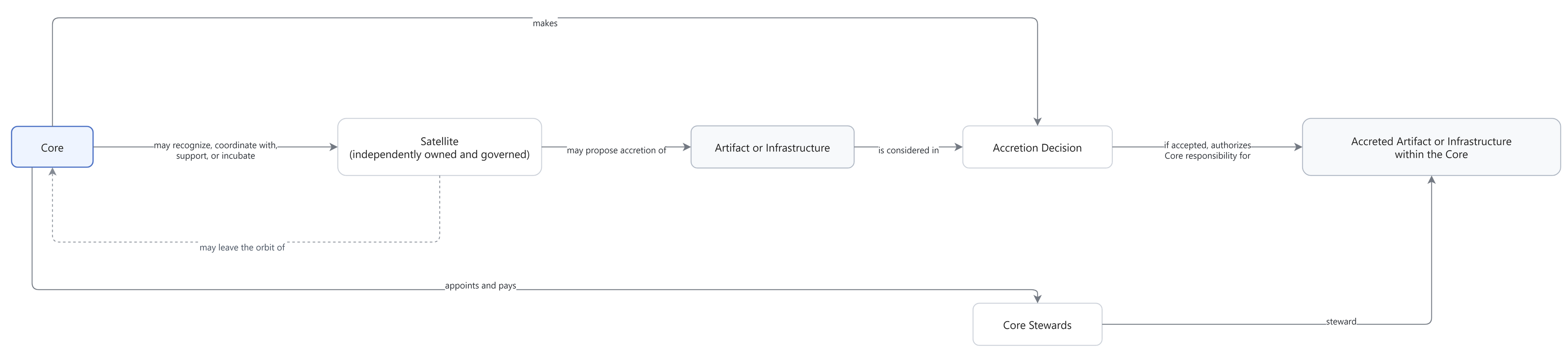
Relationships between a Core and a satellite can change without making responsibility ambiguous. A Core may incubate or support a satellite while the satellite remains independently owned and governed. The satellite may continue, change, or leave the relationship.
A satellite may later propose accretion, meaning that the Core explicitly accepts continuing responsibility for an artifact or infrastructure. If accepted, the Core identifies what it has assumed, appoints responsible stewards, and establishes the authority and resources needed to maintain that artifact or infrastructure. Funding or incubation alone never causes accretion of an artifact or infrastructure.
Example
The Research Infrastructure Core might help an application grow from incubated work into an independent satellite. The application could continue exposing research outcomes while depending on shared infrastructure supported by the Core.
If the satellite later developed a registry, standard, or other infrastructure component whose durable common stewardship served the mission, it could offer that component to the Core. The Core would assess the responsibility separately from its relationship with the application or satellite.
22. Multiple Cores and Shared Dependencies
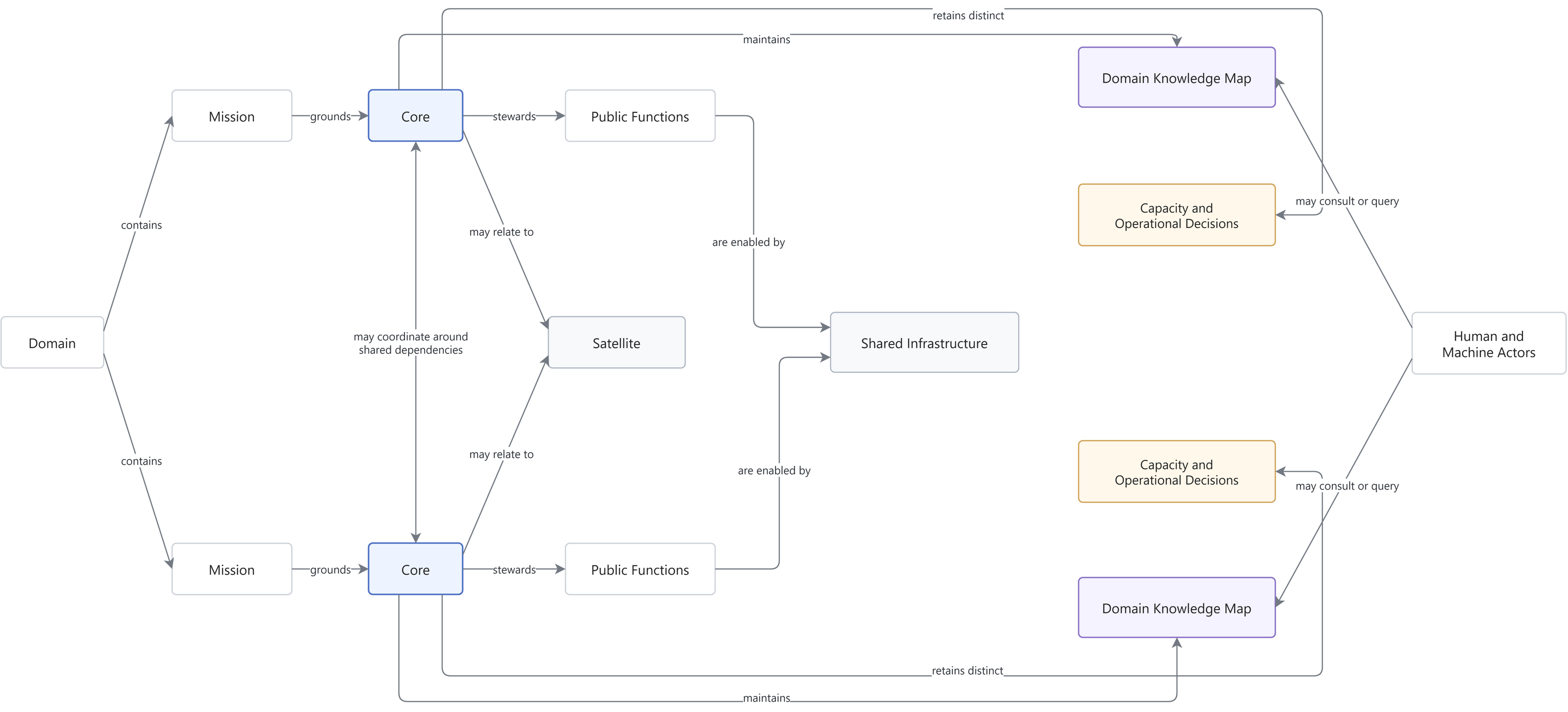
A domain may contain several missions and Cores. Infrastructure can enable public functions required by more than one mission. A satellite may also relate to several different Cores. Cores may coordinate around shared dependencies without combining their membership, authority, or judgment.
No Core must monopolize a domain; each Core remains grounded by its mission and maintains its own Domain Knowledge Map. Human and machine actors decide which maps to consult and which conclusions or trust signals to rely on.
Example
The Research Infrastructure Core may share protocols, registries, archives, preservation systems, or AI interfaces with Cores grounded by narrower scientific missions. A Core organized around astronomy and another organized around climate research may rely on some of the same identifier, transport, execution, or preservation infrastructure.
Those Cores could coordinate support for a shared dependency while retaining distinct missions, maps, capacities, and decisions. The Research Infrastructure Core could address the dependency's broad research-record function while a field-specific Core addresses requirements arising from its own domain.
23. The Complete Model
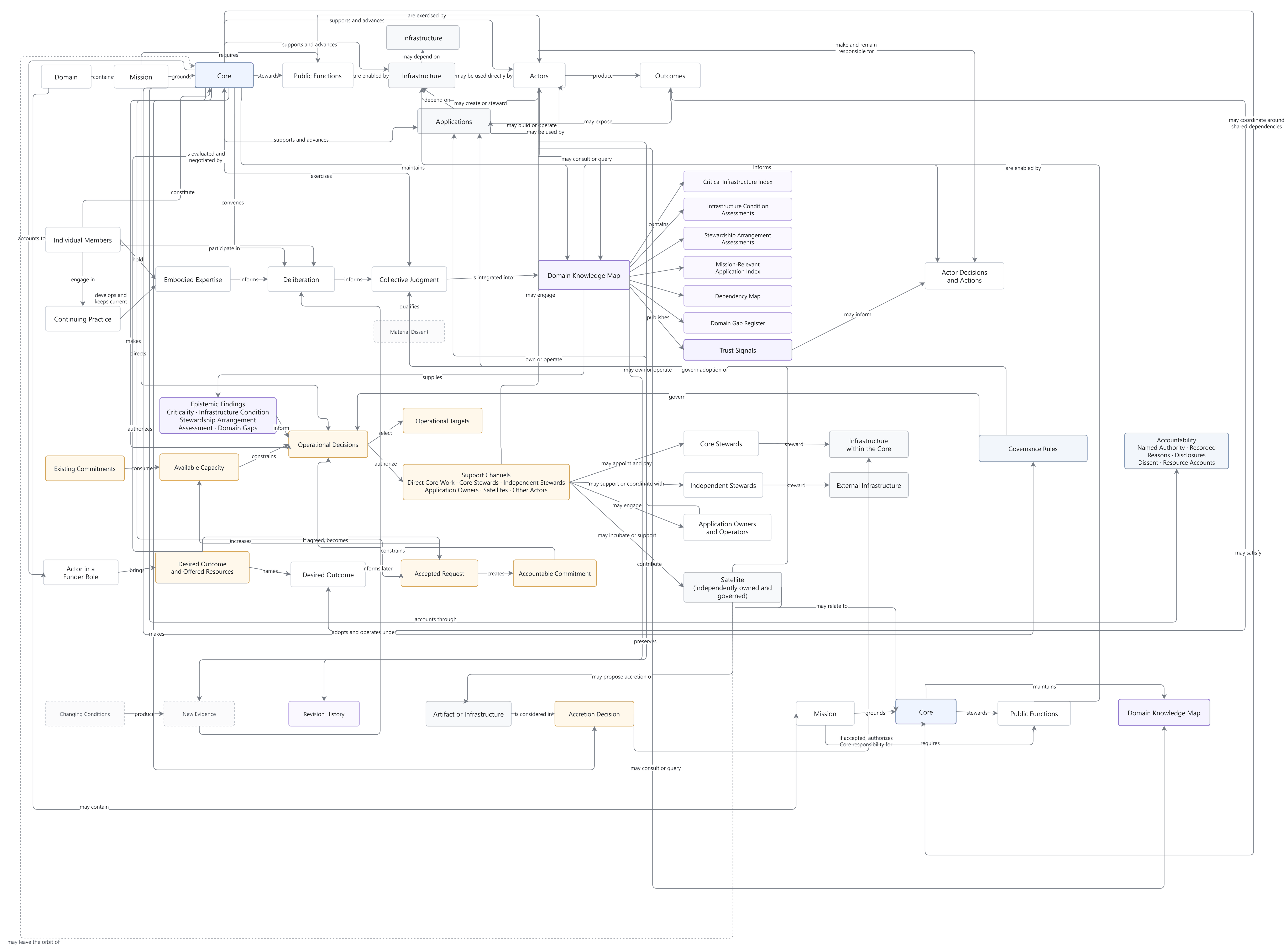
The complete model begins with a domain, a mission, and a Core. The Core stewards the required public functions of its mission. Actors engage with those functions by exercising them or by creating, maintaining, operating, stewarding, or improving the infrastructure that enables those functions. The same actor may do both kinds of work. Exercising a function and working on infrastructure both produce outcomes. Actors may also produce, maintain, operate, or use applications. Applications may mediate actors' use of infrastructure while they produce outcomes or expose existing outcomes to other actors.
Members bring their current embodied expertise into Core deliberation. Through its governing processes, the Core authorizes collective conclusions using the domain-specific questions, assessment criteria, classifications, and reliance policies it has defined. It integrates those conclusions into a Domain Knowledge Map made available to people and machines. The map and its conclusions do not themselves commit the Core to action.
The Core's operational utility begins when it combines its mission, Domain Knowledge Map, existing commitments, and available capacity to select targets and support channels. Its authorized conclusions and assessments inform but do not dictate this choice. The Core may work directly, appoint Core stewards, support independent stewards, engage application owners and operators, incubate satellites, or work through other actors. Responsibility remains with the appropriate actor unless the Core explicitly accepts that responsibility.
An actor in a funder role may bring a desired outcome and offered resources to the Core. The resources increase the Core's capacity if the Core accepts the request. The resulting agreement also creates an accountable commitment for the Core. The Core uses its expertise to determine the route through the domain without allowing the desired outcome to dictate a project list. It remains accountable for its commitments and use of resources, while supported actors remain responsible for their work and the outcomes they produce.
Example
For the Research Infrastructure Core, the model begins with the mission to maintain and advance the shared public research record so that knowledge remains identifiable, attributable, discoverable, inspectable, executable where applicable, correctable, and preservable. Its Research Infrastructure Knowledge Map identifies critical infrastructure, records infrastructure condition and stewardship assessments, identifies mission-relevant applications, maps shared dependencies and domain gaps, and publishes scoped trust signals for people and AI systems. Changing conditions produce new evidence and revised map entries. Satellites remain independent unless the Core explicitly accepts responsibility for a defined artifact. Multiple Cores may coordinate around shared dependencies while retaining distinct missions, maps, capacities, authority, and decisions.
